The Cost of Keeping Heirs' Property Homes in Use, Compared with Building New Homes
National counts of unresolved estates and vacant homes, and the published cost of preventing, resolving and returning them to use
Abstract
In Harris County, Texas, a national screen of parcel records flagged 6,340 homes and lots as probable unresolved estates. County ownership records and death records raised that count to 20,180. This paper sets out what the national screen shows, why it is a minimum, and what it would cost to act on it.
The Project Guardian national parcel screen covers 3,144 counties and 93.2 million family-owned residential parcels. It flags 385,694 probable unresolved estates with $62.8 billion in recorded value; these are screening results that require county validation. Estate homes are twice as likely to be vacant as other homes in the same county, and 37% are in low- or moderate-income census tracts. Using published program costs, preventing an unresolved estate costs about $3,000 to $5,000 per home, and clearing title and making needed repairs on an estate home that is not vacant costs about $5,700 to $14,100. A same-size new home costs about $215,460 to build, before land and public infrastructure.
1. Probable unresolved estates in national parcel records
The national parcel screen flags a record as a probable unresolved estate when the owner name carries estate, heirs or deceased wording. These are screening results, not legal findings; each requires county validation. The screen flags 385,694 such records: 363,413 homes, 12,489 untyped residential parcels and 9,792 undeveloped residential lots.
| Measure | Unresolved estates | Comparison |
|---|---|---|
| Records | 385,694 | Out of 93.2 million family-owned residential parcels |
| Recorded (county-assessed) value | $62.8 billion | Median $106,730, 60% of the median in the same county |
| Years since last recorded sale (median) | 17.4 | About 10 for residential parcels in the same counties |
| In low- or moderate-income tracts | 37% | 25.5% expected from the counties they are in (Section 4) |
Rates vary more than a hundredfold between counties. That spread mostly reflects whether a county records estate status on the owner record, not how often owners die without a will. Philadelphia shows the gap directly: deed research by The Pew Charitable Trusts found 10,407 tangled titles caused by an owner's death among 509,258 residential properties, 20.4 per 1,000, while parcel records flag 0.41 per 1,000.
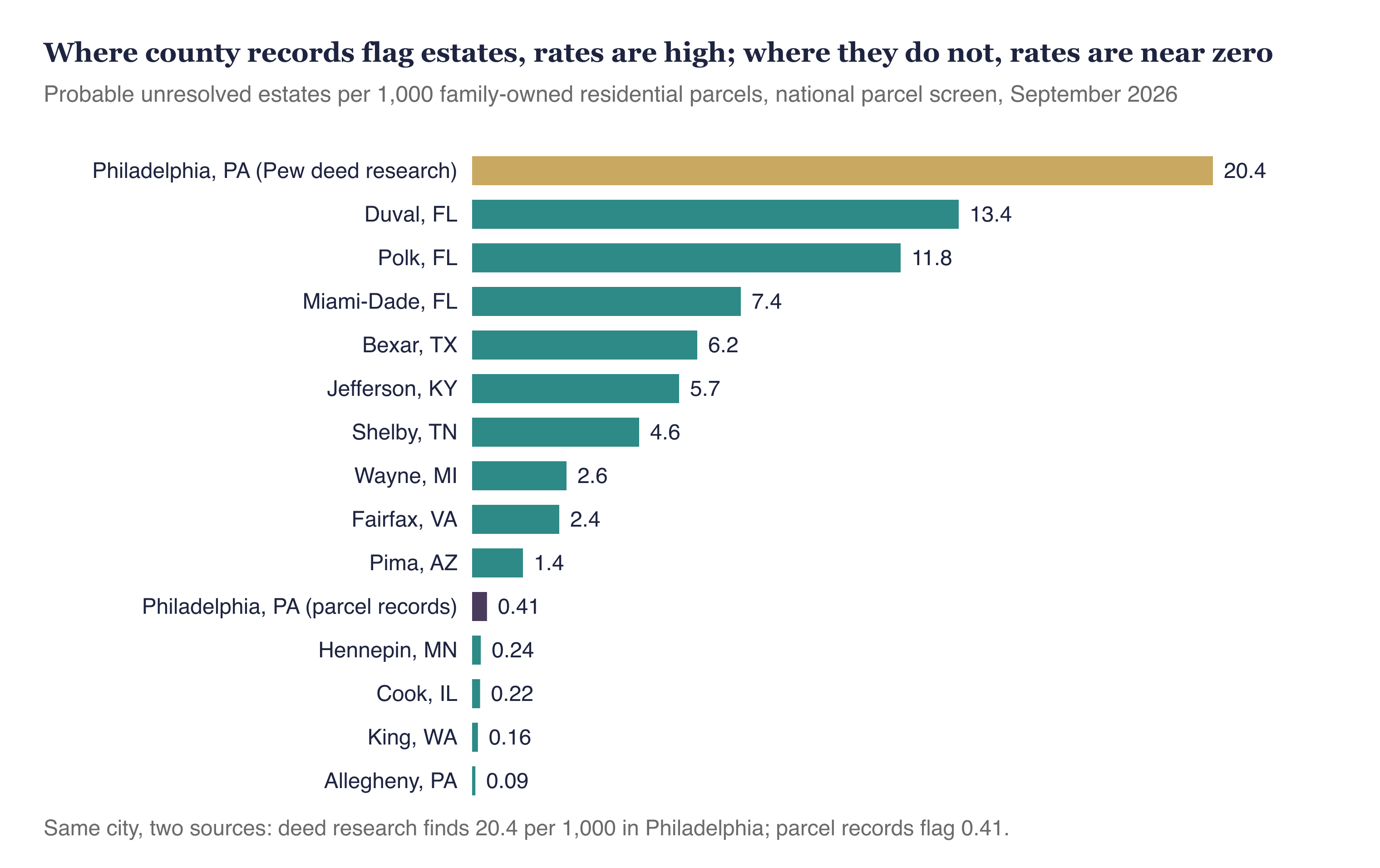
About 80% of flagged estates are in Southern states, where tax rolls commonly mark EST, HEIRS or DECD on the owner name. Half are in 118 counties. That concentration combines where heirs' property is common with where it is recorded.
2. Parcel records undercount unresolved estates
Harris County shows how much a county review adds. County appraisal district (HCAD) owner records carry estate wording that the national parcel data does not, raising the count from 6,340 to 11,121. Matching death records then added 9,059 records where the owner has died but nothing in the ownership record shows it, for 20,180 in all.
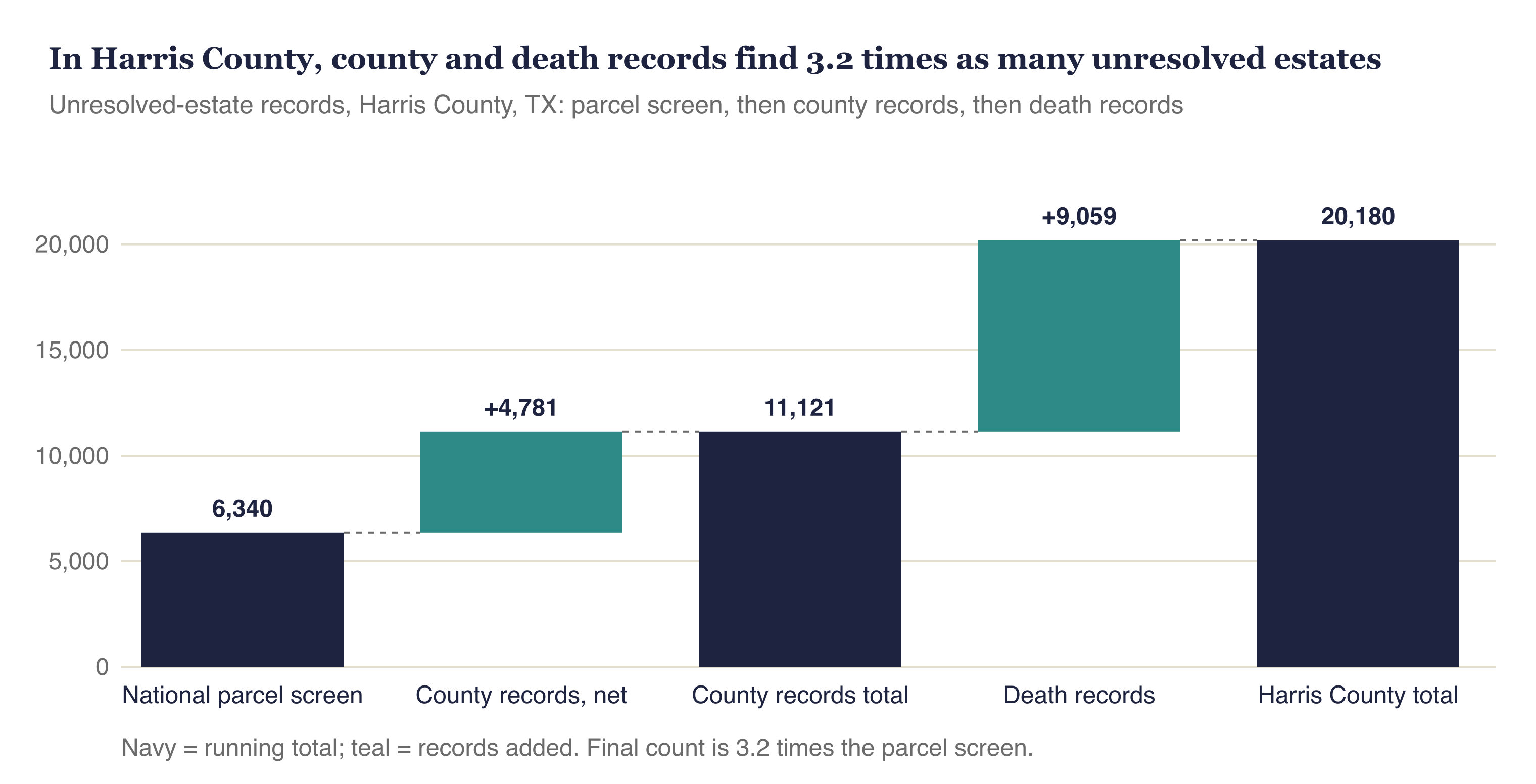
Where the parcel screen does flag an estate, it is usually right: in the September Harris County reconciliation, county records confirmed 96% of the parcel-screen estates (6,098 of 6,340). The screen's weakness is what it misses.
3. Vacant homes
USPS flags 1,509,532 household-residential parcels as vacant nationally, 1.5% of homes with a known USPS status (October 4, 2026 data). A quarter of them are in 24 counties and half are in 118. In the most affected counties with 50,000 or more homes, about 1 home in 12 is flagged vacant.
Estate homes are vacant far more often. Of the 363,413 estate homes, 14,595 (4.0%) are flagged vacant, against 2.0% expected if each had its own county's vacancy rate. The 4.0% counts estate homes with no USPS status (44,201 in the September data) as not vacant; among homes with a status, the September rate was 4.5%. Estate homes are more often vacant than other homes in 89% of the 172 counties with at least 500 estate homes. Together, unresolved estate, multiple-owner and At-Risk records account for 67,774 vacant homes, including 1 in 7 vacant homes in Duval County, Florida.
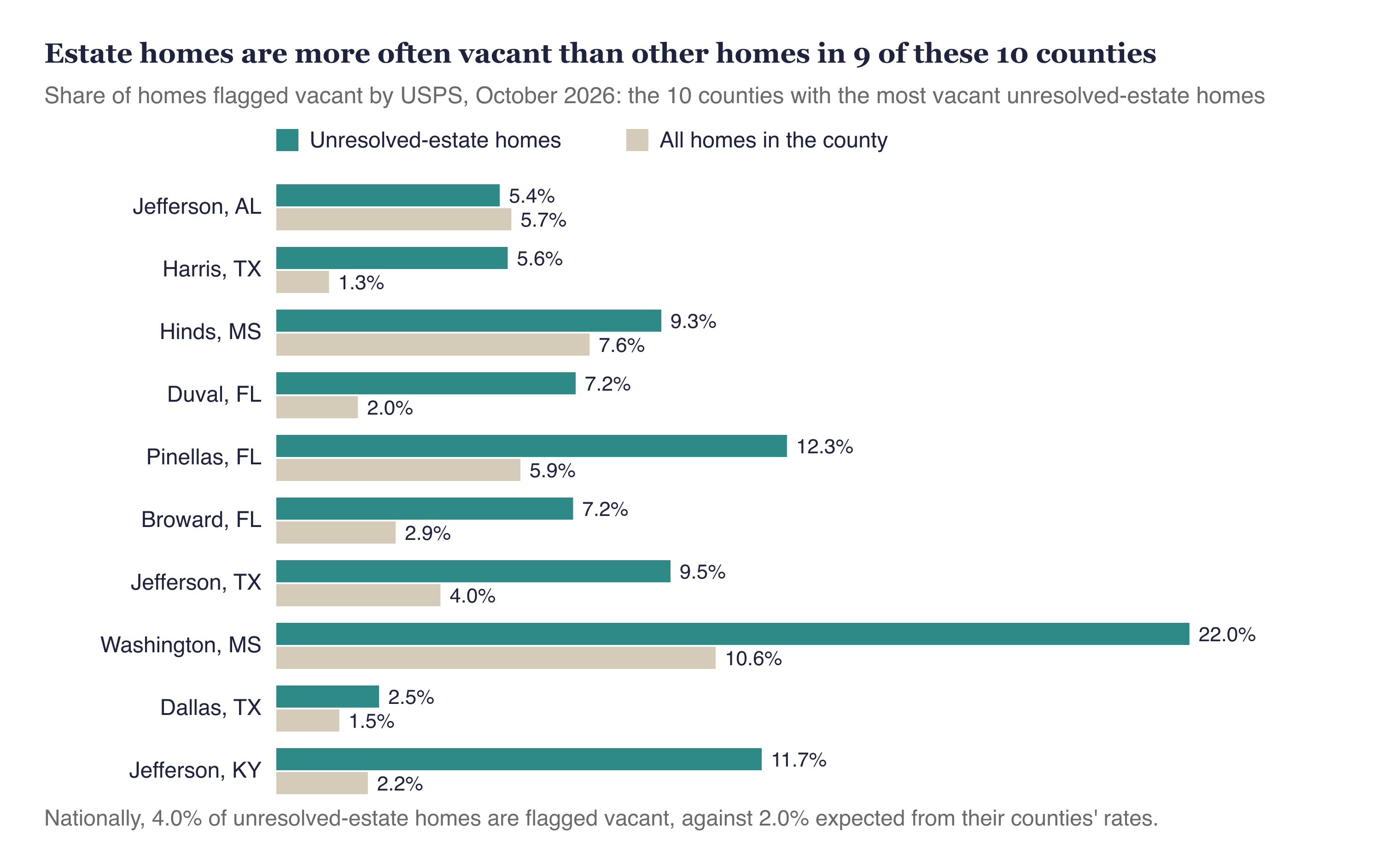
Vacant estate homes are older and lower-valued than other estate homes: median year built 1954, with 39% built before 1950, and a median recorded value of $57,838, 41% of their county's median. A vacant-home program that does not clear title cannot reach them, because no one can sell, finance or repair the house until the estate is resolved.
4. Unresolved estates and tract income
Of the 385,694 unresolved estates, 140,976 (36.6%) are in census tracts the FFIEC classifies as low or moderate income. If each estate had its own county's mix of residential parcels, about 25.5% would be, so estates are about 1.4 times as concentrated in these tracts.
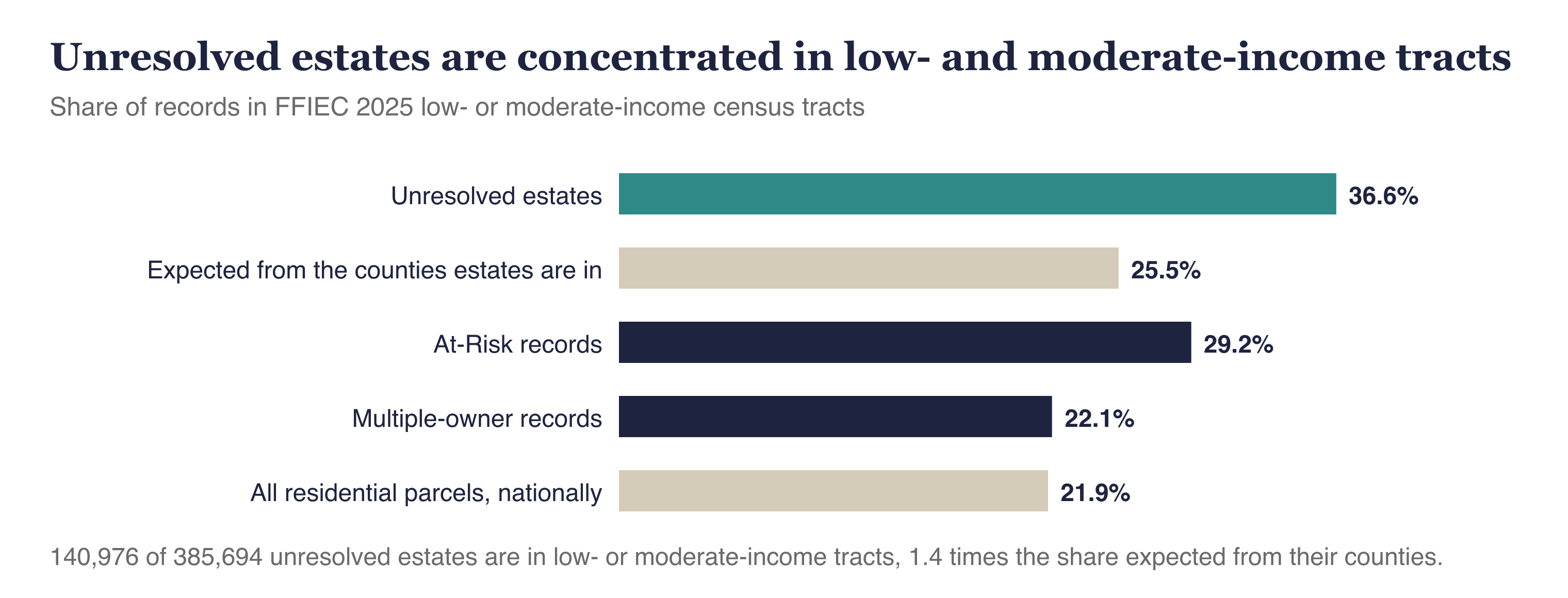
Across the 585 counties with at least 100 estates and at least one low- or moderate-income tract, the share ranges from 19% to 49% for the middle half of counties. In Florida, where ownership records are updated automatically when an owner dies, the share is 43%, against 38% elsewhere. Where a county relies on families to report a death, estates of lower-income households are likely to be undercounted.
5. Cost per home of preventing, resolving and returning estates
A program built on the three Project Guardian categories has three paths. Prevention serves At-Risk and multiple-owner records; title clearing serves unresolved estates that are not vacant; title clearing with rehab serves vacant ones. Every cost below is a published program or survey figure. Ranges show the published figures that bracket each cost; they are not statistical ranges for estate homes.
| Path | Who it serves | Homes | Cost per home | What the cost covers |
|---|---|---|---|---|
| Prevent | At-Risk and multiple-owner records | Up to 3.1 million | $3,000 to $5,000 | Will, power of attorney and a deed that passes the home at death |
| Resolve, family stays | Unresolved estates USPS lists as not vacant | 304,726 | $5,690 to $14,118 | Title clearing ($5,690 to $9,198), plus repairs where needed: none at the low end; $4,920, the average for households below the poverty line, at the high end ($4,062 is the average for all homes needing repair) |
| Return, heirs keep and rehab | Unresolved estates USPS lists as vacant | 14,486 | $65,690 to $169,198 | Title clearing and rehab ($60,000 to $160,000) |
| Return, heirs sell to a nonprofit, which rehabs | Unresolved estates USPS lists as vacant | 14,486 | $123,528 to $227,036 | Title clearing, purchase at median recorded value ($57,838) and rehab |
| Build new | Same-size home | $215,460 | Construction only: $162 per square foot × 1,330 square feet; excludes land and public infrastructure |
Sources: title clearing, Pew Charitable Trusts (2021), with the low end excluding Pennsylvania inheritance tax for states without one; repairs, Federal Reserve Bank of Philadelphia (December 2025), averages for two household groups rather than a range for estate homes; rehab, Cuyahoga Land Bank (2025); estate planning, Legal Aid Society of Palm Beach County (2026); construction, NAHB 2024. Multiple-owner records include ordinary co-ownership, so 3.1 million is an upper bound. Home counts by USPS status are from September 2026 data, so the groups add up: 304,726 not vacant, 14,486 vacant and 44,201 with no status, 363,413 estate homes in all. Section 3 uses the October 2026 vacancy match (14,595 vacant).
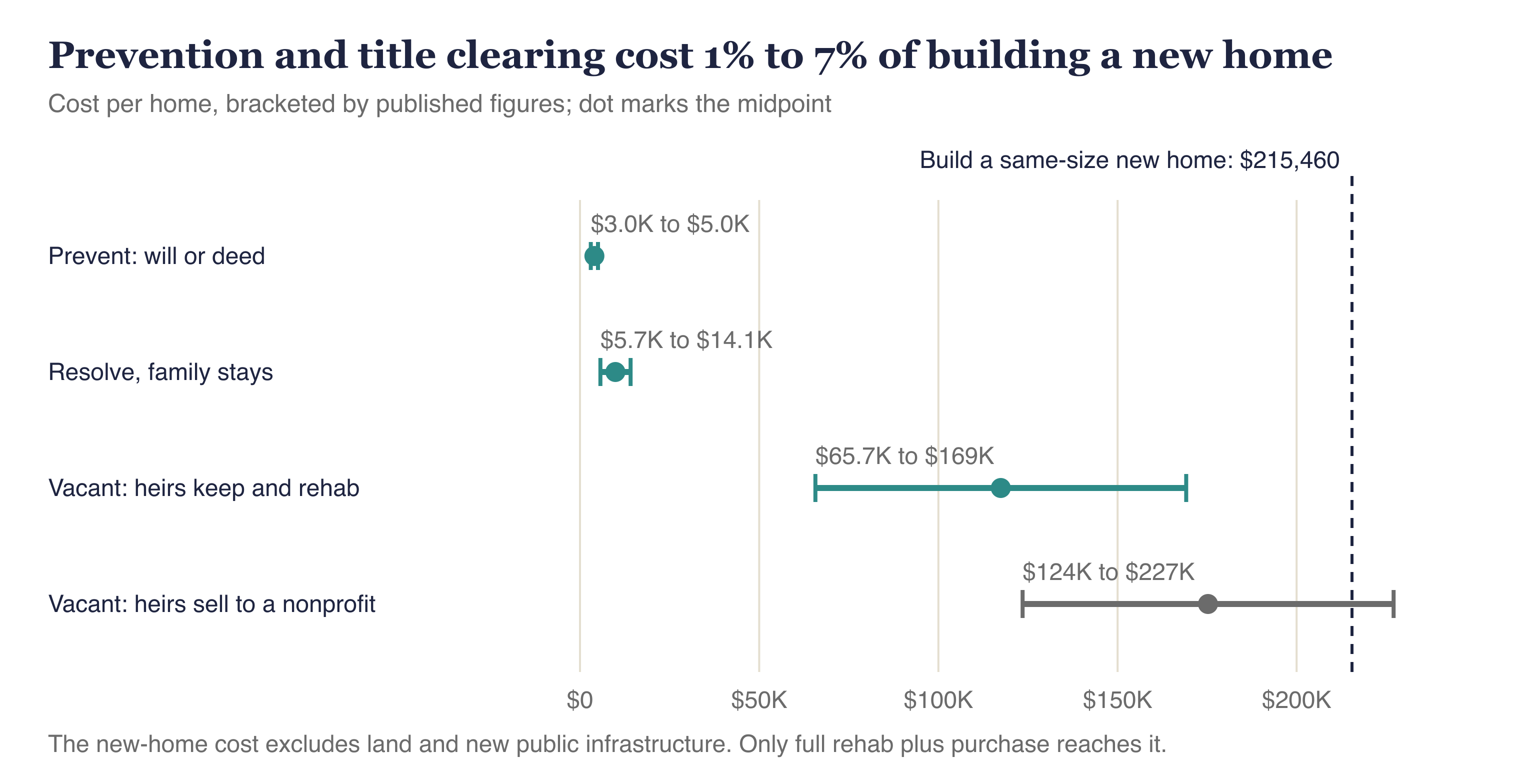
Per 1,000 homes, prevention costs about $3 million to $5 million and resolving estates that are not vacant about $6 million to $14 million, against $215 million to build 1,000 new homes. Returning vacant homes costs $66 million to $227 million per 1,000; it is cheaper than building unless a nonprofit must buy the house and fully rehab it.
6. Public infrastructure
The new-home figure leaves out the streets, water and sewer lines a new home needs. A May 2026 study for The Pew Charitable Trusts, modeling 10 states including Florida and Texas, found that new homes near jobs, stores and transit need about $21,000 less upfront public infrastructure per home than homes on the edge of town, and cost half as much a year to maintain.
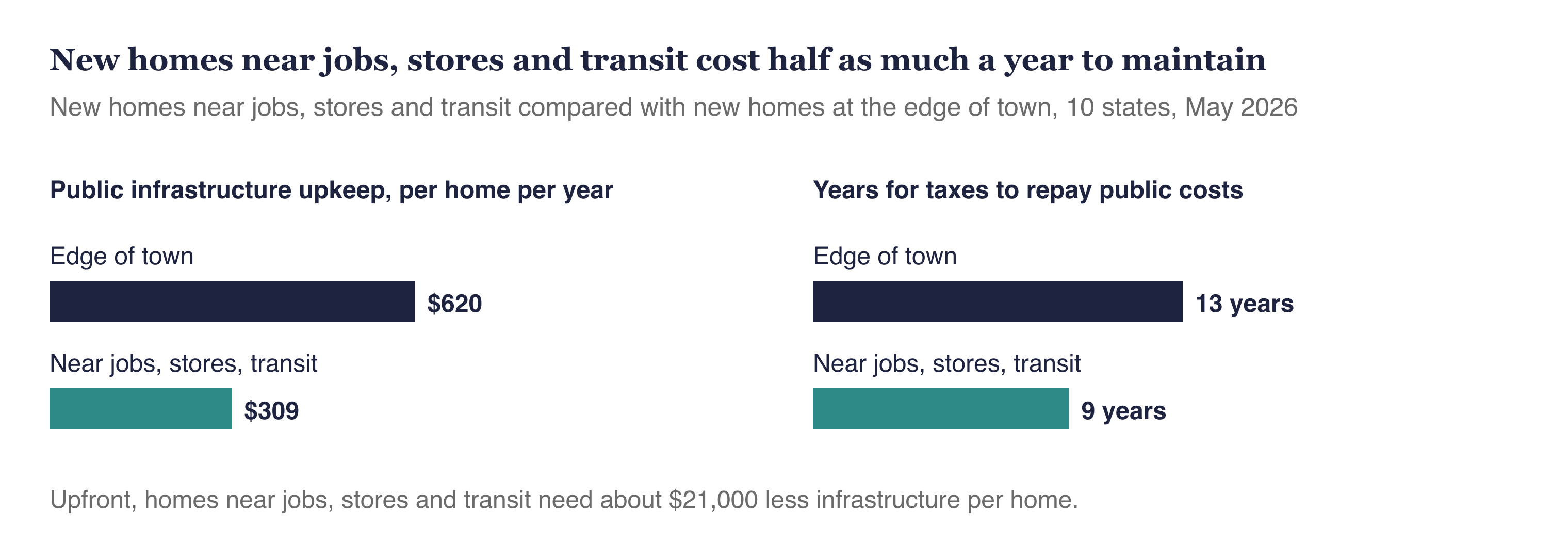
The study compares new homes in two locations; it does not estimate existing homes. A vacant estate home returned to use is on a street already served by water and sewer lines, so no new lines have to be built for it. The study's figures describe new construction and should not be read as savings per existing home returned to use.
7. What a pilot would measure
The costs above are national stand-ins. A pilot in five counties would replace them with local figures and measure results directly:
- Estate counts before and after matching parcel records to county ownership records and death records, and the low- or moderate-income share before and after.
- Cost per home for each path, from local legal aid, title and rehab providers.
- Titles cleared, months from first contact to clear title, and loan dollars per cleared title (purchase, refinance, renovation and rehab).
Candidate counties include Duval, Florida; Miami-Dade, Florida; Jefferson, Alabama, which has the most unresolved estates nationally (11,860); Dallas or Harris, Texas; and Jefferson, Kentucky.
8. Limitations
- The national screen uses only Regrid parcel fields. It identifies probable unresolved estates for outreach; it is not a legal determination of title status, and every county result requires validation with county records.
- Counts are minimums. Parcel records omit estates that counties do not flag, and 54 counties could not be screened because Regrid supplies no residential land-use codes for them.
- Recorded value is the county assessment and is usually below market value.
- Cost figures are published estimates from other places and programs, not Project Guardian measurements. Rehab costs come from Midwest land banks and may differ in Southern counties. Contested estates and quiet-title actions cost more than the straightforward case priced here.
- The 1,330 square-foot median home size behind the new-home cost comes from four counties (Jefferson, Kentucky; Orange, Florida; Pima, Arizona; Cook, Illinois) and is not yet confirmed nationally.
- Transfer-on-death deed rules differ by state. Florida uses Lady Bird deeds, Alabama has no transfer-on-death statute, and Texas and Mississippi have statutes; status should be confirmed against current law in each pilot state.
- Tract income measures the neighborhood, not the household.
- Regrid licensed parcel data, national delivery; Project Guardian national parcel screen, run national_2026-09-29 (algorithm regrid_cat3_v6_2026_09_24).
- USPS vacancy and residential delivery indicators in Regrid parcel records: September 2026 status groups in Section 5 and October 4, 2026 vacancy match in Section 3.
- Harris County Appraisal District 2026 preliminary ownership data and death-record matching; Project Guardian Harris County classification, October 16, 2026.
- FFIEC 2025 Census Tract List .
- The Pew Charitable Trusts, How Tangled Titles Affect Philadelphia, August 2021 .
- Federal Reserve Bank of Philadelphia, Home Repair Costs, December 2025 .
- Signal Cleveland, reporting on the Cuyahoga Land Bank Board of Directors, July 2025 .
- Legal Aid Society of Palm Beach County, Heirs' Property Project, August 2026 .
- National Consumer Law Center, Protecting the Family Home: Transfer-on-Death Deeds, August 2026 .
- National Association of Home Builders, Cost of Constructing a Home, 2024 survey.
- The Pew Charitable Trusts, Building Homes Near Jobs, Stores, and Transit Saves Public Dollars, May 27, 2026 .
Figures in this paper should be cited with their source date, denominator, geography and method version: national counts from the September 29, 2026 parcel screen (algorithm v6) over family-owned residential parcels in 3,144 counties; Section 5 USPS status groups from September 2026 and Section 3 vacancy from October 4, 2026 USPS data; Harris County from the October 16, 2026 county classification. Cost figures are published estimates and should be cited to their original sources.